A Record of Alteration
The Flesh Sculptor
I. THE MAN WHO WAS SET ASIDE
The Injury That Did Not Kill Him
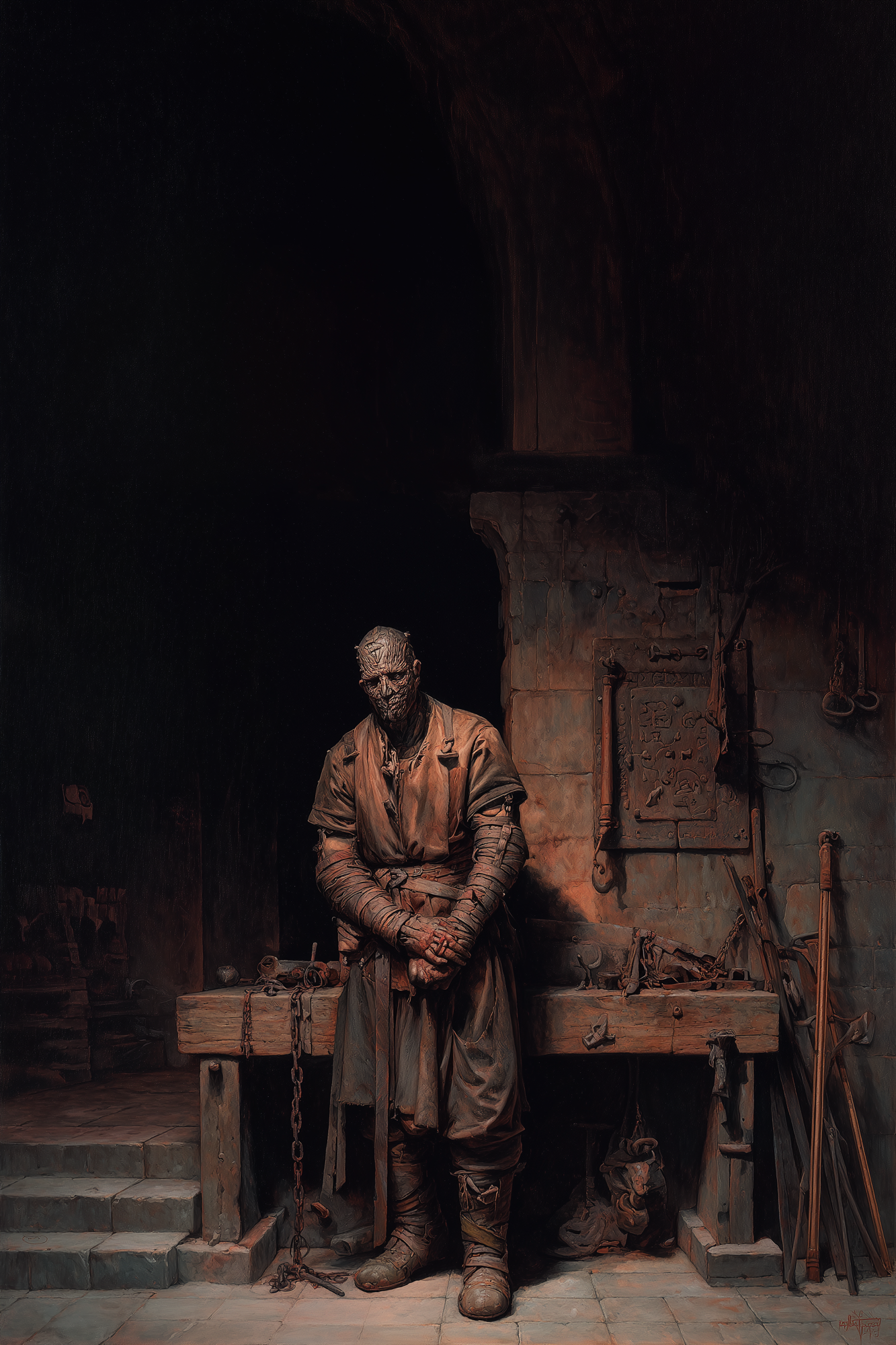
Before he was known for what he made, he was known only for what he could endure. He fought in the early wars not as a hero nor as a commander, but as one of the countless bodies pressed forward until something failed. He did not lead. He did not decide. He advanced until the war reached into him and took something it required. When his arm shattered beneath a blow meant for another, the damage was not spectacular. There was no clean severing, no moment worthy of song. The bone splintered inward.
The nerves survived. The limb remained attached. It could still move. It could no longer serve. That was enough. He was removed from the field and placed among the living wounded, those who were not dying correctly. Men whose bodies had failed without granting release. Men whose injuries did not justify remembrance. They lay together for weeks, listening to the war continue without them. The sounds of battle did not fade. They simply moved farther away. No one asked what they had learned.
No one waited for their return. The dead were honored. The whole were reassigned. The damaged were left to recover into irrelevance. It was there he learned the first truth. War does not judge bodies. It measures them. And it discards what fails.
II. THE LIE OF REPAIR
Why Healing Offended Him
They spoke to him of recovery. Physicians promised function, not purpose. Priests promised meaning, not usefulness. Both spoke as if restoration were a moral act, as if the body were a mistake to be corrected rather than a result to be accepted. He listened without protest. What disturbed him was not pain, but insistence. The certainty with which they believed his body should be returned to what it had been. As if the battle had not spoken clearly.
As if the fracture were an interruption rather than a verdict. The war had tested him. The war had answered. Everyone else wished to pretend the question had never been asked. He began to see healing as denial. Not refusal of suffering, but refusal of outcome. An attempt to erase evidence that something had been measured and found insufficient. That refusal stayed with him long after the bone set and the scar hardened. Long after the limb regained movement. Long after others told him he should be grateful.
Gratitude, he learned, was expected of those who were allowed to return.
III. THE DECISION TO ALTER
Why He Never Sought Wholeness Again
When he altered himself, it was not to improve. It was to finalize. The damaged limb was reinforced, not repaired. Iron was fused where bone had failed. Movement was restricted rather than restored. Pain became constant, manageable, predictable. A steady presence rather than an intrusion. There would be no return. In doing so, he severed himself from the illusion that had disgusted him most, the belief that bodies are temporary states rather than permanent outcomes. Flesh records events.
Bone remembers pressure. Iron does not forget. He did not do this in secret. He did not justify it. He did not ask permission. He simply made the damage honest. Those who saw the alteration mistook it for penance. Others assumed obsession. Both were wrong. It was not punishment, and it was not desire. It was acceptance without apology.
IV. THE DEMON QUESTION
Why He Chose Them
Demons were not chosen because they were strong. They were chosen because no one objected. No treaties protected them. No priests mourned them. No chronicles counted their suffering as loss. They were already spoken of as corruption, infestation, excess. Their destruction did not require explanation. The Flesh Sculptor recognized this immediately. A category without defenders. A body without advocates. Material without consequence. He did not hate demons. Hatred implies emotion. Emotion implies distortion.
He saw them as the only honest starting point. A form already defined by rejection. A substance already removed from moral accounting. If something was to be reduced to function, it should begin where function was all that remained.
V. THE REMOVAL OF HANDS
Function Over Hesitation
The first alteration was always the same. Hands were removed. Not as punishment. Not as symbolism. But because hands remember being human. Hands grasp, hesitate, release. Hands fumble. Hands doubt. Weapons do not. By replacing forearms with integrated implements of violence, he removed choice from the act. The body no longer decided whether to strike. It no longer negotiated distance, force, or consequence. It only fulfilled its shape. Those who survived the process became usable.
Those who did not were recorded and discarded. There was no mourning. There was no pause. Iteration replaced mercy. Over time, patterns emerged. Subjects without hands adapted faster. Subjects without hands exhibited fewer delays, fewer errors, fewer expressions that required correction. The absence of grasp reduced hesitation. The absence of touch reduced memory. What remained was motion.
VI. THE WARFORMS
Bodies That Cannot Lay Violence Down
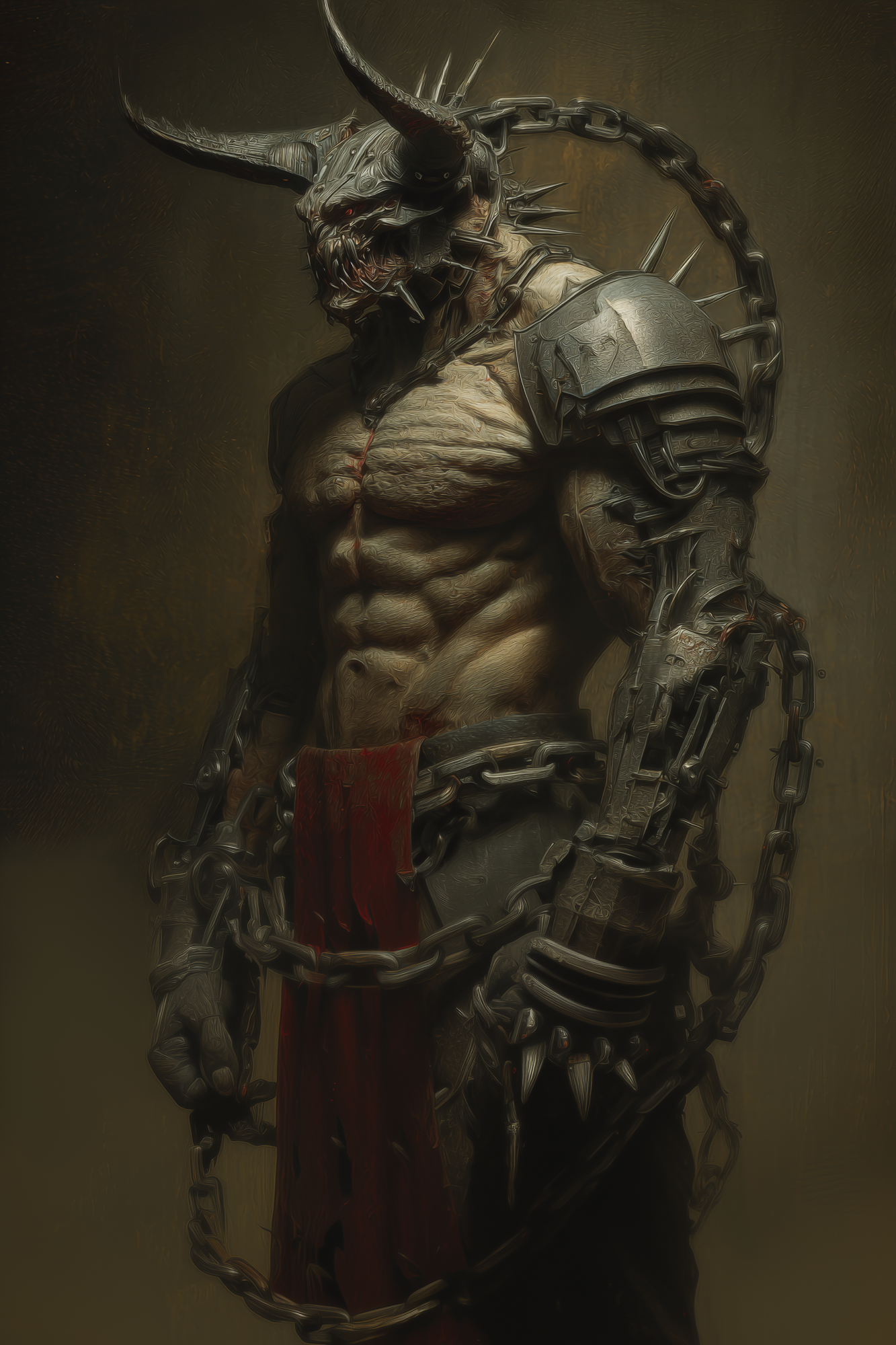
The war creations were never meant to inspire fear. Fear is unstable. Fear hesitates. They were meant to be final. Their bodies remained flesh dominant, scarred and thickened by repeated intrusion. Iron was fused directly into muscle and bone, not worn, not mounted, not removable. Chains were embedded where posture demanded it, drawn through shoulders, backs and spines to anchor force and alignment. Nothing about them was ornamental. Nothing could be removed without killing them.
Their forearms ended in weapons grown from anatomy itself. No grips. No tools. No separation between intent and impact. Violence could not be set down. It could only be exhausted. Each form that survived battle became precedent. Each form that failed was erased. There was no archive of the discarded. Only the continued existence of what worked. Identity dissolved through repetition. Function remained.
VII. THE BLACK FORTRESS
Where Process Replaced Meaning
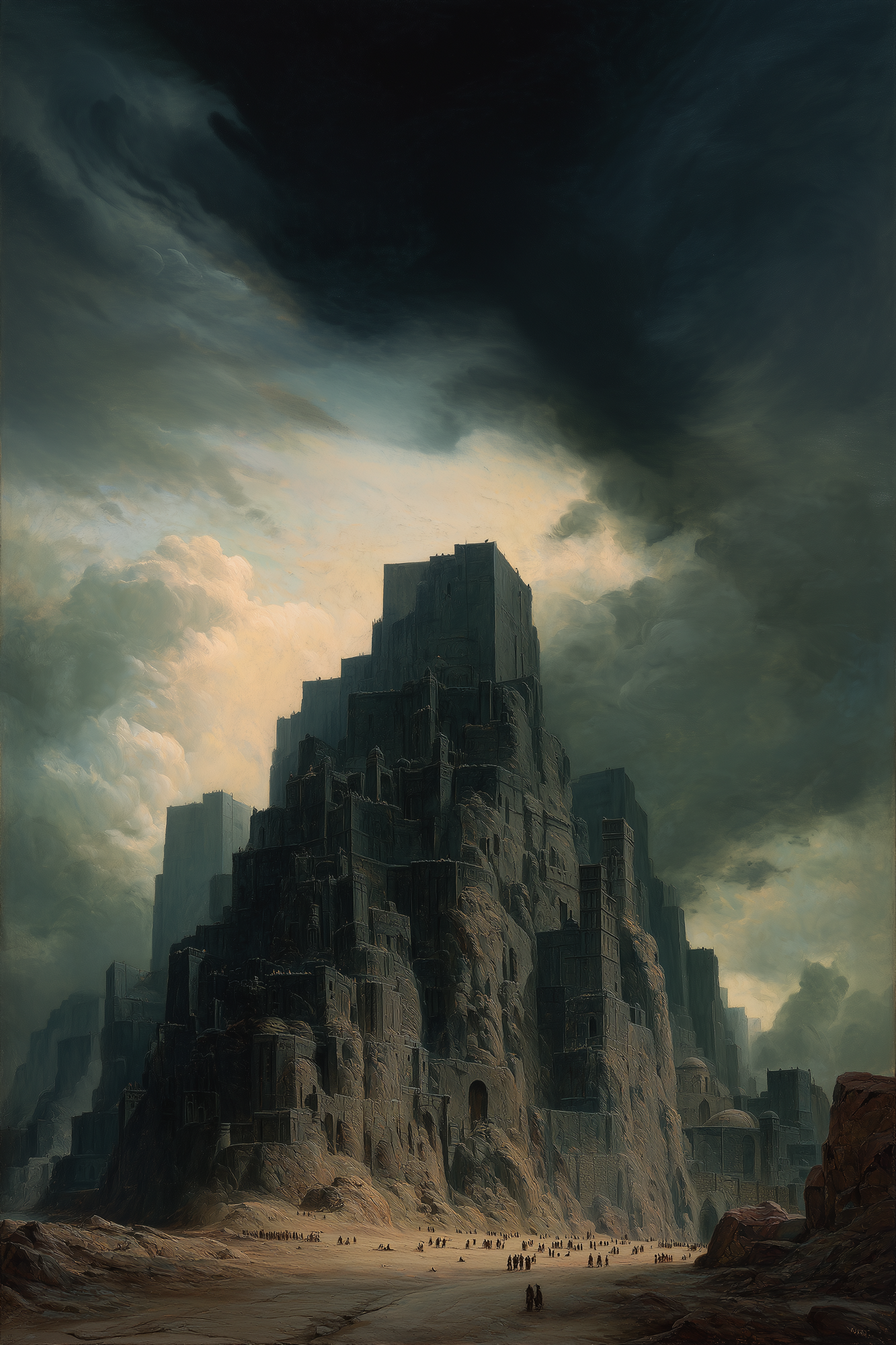
The Black Fortress was not designed. It accumulated. Each chamber exists because a body once required space. Each iron ring was placed where restraint proved necessary. Each groove in the stone marks repetition, not intention. Chains were embedded into walls because they were used too often to be removed. Floors were scarred because dragging bodies was more efficient than carrying them. Cages were built tall enough to stand in and narrow enough to prevent movement, not for cruelty, but for staging.
Nothing in the fortress was symbolic. Nothing was ceremonial. Every structure answered a practical problem. Silence was enforced because screams interfered with concentration. Light was limited because shadow revealed posture more clearly. The air was kept cold because heat distorted flesh. Those who entered did not feel dread. They felt procedure. The fortress did not ask what should be done. It existed to ensure that it could be done again.
When the Flesh Sculptor moved through the fortress, no one announced him. He did not hurry. The iron fused into his own frame made haste inefficient. Each step produced a measured sound, metal against stone, not heavy, but inevitable. He paused where chains crossed incorrectly. He adjusted tension without looking at the face attached to the body. His altered limb rested against iron supports as if they were extensions of himself. Pain registered. It was irrelevant. He remained seated during observation.
Iron supported iron. Flesh sagged where it had learned to. When a subject strained against restraint, his gaze followed the motion, not with interest, but with calibration. When something worked, he did not smile. When something failed, he did not react. He marked it. He waited.
VIII. CONTINUATION
The Project Remains Active
The Flesh Sculptor did not complete his work. The work stabilized. Iteration slowed, but did not end. When forms repeated too precisely, deviation was introduced. When survival rates grew predictable, conditions were altered. Control was never abandoned. It was refined. The project persists because war continues to provide data. The Sculptor no longer intervenes constantly. He observes patterns.
He is summoned when a result contradicts expectation, when a body performs beyond its projected capacity, when violence produces something new. He is still present. Still altered. Still seated upon iron when observation is required. The system does not worship him. It relies on him.
IX. CHAIN-RECORD: SUBJECT [UNNAMED]
Recovered Composite Record
Cross referenced with observation logs
FRAGMENT III. DISORIENTATION
[OBSERVATION]
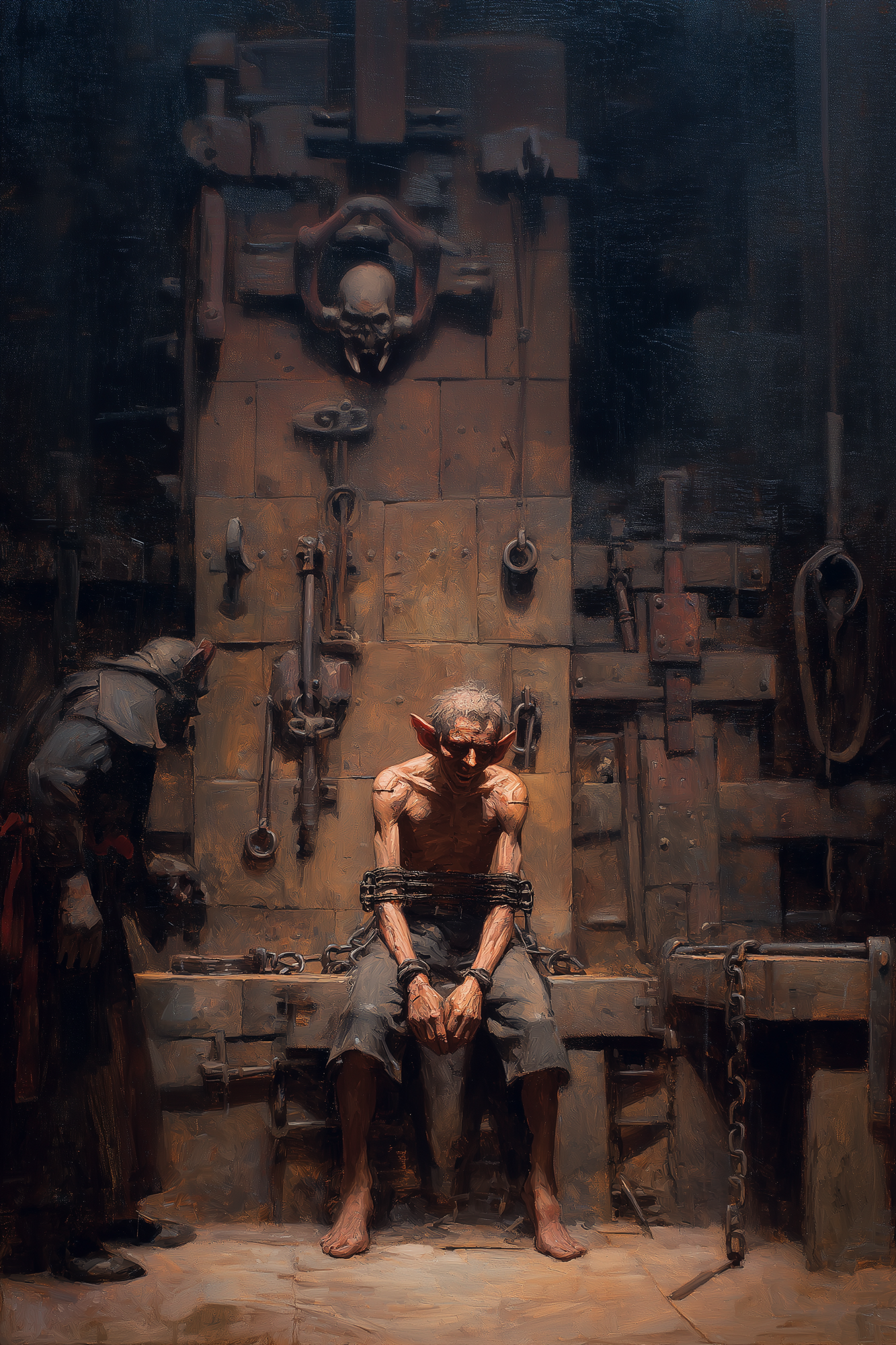
Subject regains consciousness. Restraints secure. Vocal response incoherent.
I cannot see where I am.
There is pain everywhere, but it does not come from one place. It moves. When I try to find it, it spreads. I try to move and something stops me. I do not know what. I do not know how much of me is still here.
I make a sound. It does not leave my body. It stays inside and shakes.
[OBSERVATION]
Elevated respiration. Muscle contraction against restraints. No directed motion.
I am afraid.
Not of something I can see. Of what is happening without asking me. My body feels wrong. Too heavy in places. Too empty in others. I do not know what they have taken. I do not know what they are going to take next.
I want this to stop.
[OBSERVATION]
Restraints tightened. Subject resistance decreases after adjustment.
When the chains pull tighter, the noise inside me lessens. I do not understand this. I do not like it. When they cut, the pain sharpens, but the fear moves. It slides away from my chest and into my limbs. When they stop, something inside me swells and presses outward.
I am not safe when they leave me alone.
[OBSERVATION]
Subject ceases vocalization. Compliance increases.
I do not know what I am.
I do not know what I am for.
I think I am going to break.
FRAGMENT IV. PRESSURE
[OBSERVATION]
Subject stands without assistance. Postural alignment stable. Weapon arms integrated.
I am upright.
The weight is correct, but something inside me is not.
The chains sit where they should. The iron holds. My balance does not drift. Still, my chest feels crowded. There is no pain. There is something worse than pain. A tightness. A pull that does not come from metal.
I do not know what it wants yet.
[OBSERVATION]
Subject exhibits minor forward lean without stimulus. No correction applied.
There is space in front of me.
Too much space.
The room feels unfinished, as if something should be there and is not. My blades feel heavy in the wrong way. Not weight. Anticipation. Like a breath held too long.
I want something to push back.
FRAGMENT V. FIRST RESISTANCE
[OBSERVATION]
External stimulus introduced. Subject advances on visual contact.
The first body breaks too easily.
This angers me.
Not because it hurts, but because it ends. The resistance collapses before I am finished with it. The blades move as they should. The sound is correct. The body fails anyway.
This is not enough.
[OBSERVATION]
Subject pauses briefly after initial strike. Elevated muscle tension noted.
Another body is placed in front of me.
Better. It pushes back. Just a little. Long enough for the blades to dig in. Long enough for the sound to deepen. There is weight behind it. Delay. Friction.
Something inside me loosens.
I want more of that.
FRAGMENT VI. NEED IDENTIFIED
[OBSERVATION]
Strike cadence increases. Subject initiates motion without chain prompt.
Step. Strike. Pull.
The pattern calms me.
When I strike, the pressure eases. When I stop, it returns. Stronger now. Sharper. It presses outward against my ribs and throat.
I begin to understand.
I do not want violence.
I want resistance.
[OBSERVATION]
Subject displays target preference. Cluster engagement improves output.
Bodies close together feel better. They press back longer. They delay the end. I angle my strikes to keep them standing just long enough. Not to spare them. To use them.
I am learning how to prolong it.
FRAGMENT VII. AGGRESSION BUILDS
[OBSERVATION]
Physiological escalation detected. No degradation in precision.
There is no room left inside me now.
The pressure has grown teeth.
When there is nothing in front of me, my blades feel wrong. Empty. Light. I hate this feeling. It crawls up my arms and settles behind my eyes, scraping.
I lean forward before the chains pull.
They allow it.
[OBSERVATION]
Chain response delayed. Subject advances beyond projected boundary.
The bodies begin to break faster again.
This frustrates me.
I strike again after they fall. I dig into what is already ruined, trying to pull more resistance out of it. There is less each time. The pressure sharpens. It does not forgive.
I grow angry.
FRAGMENT VIII. BLOODRUSH
[OBSERVATION]
Adrenal response extreme. Pain indicators absent.
The world narrows.
Faces vanish. Shapes become weight. The only thing that matters is how hard they push back before they give. Distance collapses. Timing dissolves. There is only contact and the moment it resists.
Blood coats my chest and mouth. I do not remember opening my mouth. I do not close it.
The sound the blades make when they meet bone fills the space inside me where thought used to be. It vibrates through my arms and into my spine. Each impact pushes back just enough.
I want them closer.
I want them many.
FRAGMENT IX. APPETITE
[OBSERVATION]
Subject resists disengagement. Vocalization recorded.
They pull me back.
This makes me furious.
Not afraid. Not confused. Furious.
There is more out there. I can feel it. The pressure is still inside me, screaming now, clawing forward. The chains deny it. They bite into my shoulders and chest. They hold.
I strain against them.
I would tear them apart if I could.
[OBSERVATION]
Aggression persists post engagement. Appetite sustained.
I am not angry because I was hurt.
I am angry because I was stopped.
I want to be sent where the bodies do not end.
I want to drown in resistance.
FRAGMENT X. STABILIZED HUNGER
[OBSERVATION]
Subject calms only when restrained. Hunger remains latent.
I stand still again.
The pressure does not leave. It settles. It coils. It waits.
I understand this now.
This is not something that will end.
This is what I am for.
X. STATUS
Ongoing aggression trajectory acceptable. Psychological degradation productive. Deployment frequency increased. The Flesh Sculptor authorizes continued use.
XI. ADDENDUM. PRIVATE NOTE
Attributed to the Flesh Sculptor
Recovered without authorization. I am often asked when the subject becomes dangerous. This is a misunderstanding. Danger is not deviation. Danger is unpredictability. What we are witnessing is not loss of control, but consolidation. The subject no longer reacts to pain, nor to fear. It reacts only to resistance, and the absence of it produces measurable agitation. This is not madness. It is alignment. Aggression is not introduced. It is revealed, concentrated by removal of competing impulses.
Memory fades because it is inefficient. Anticipation replaces it because anticipation sustains output between engagements. The hunger observed is not a flaw. It is the mechanism by which the form preserves itself. If the subject ever ceases to desire engagement, then correction will be required. Until then, escalation remains productive. The project is not complete. It is approaching clarity.
XII. ARCHIVAL NOTE
The following document circulated among archival personnel following the stabilization of the Sculptor’s later warforms. Its distribution was limited but persistent.
XIII. CHAIN-RECORD: COMMENTARY NODE
Author: [Redacted]
Status: Authorized Peripheral Analysis
Circulation: Restricted
I first encountered the Flesh Sculptor through criticism. People described his work as excessive, as if excess were the point. They spoke of iron and chains and altered bodies as if these elements existed to provoke rather than to solve. Their language was emotional. Their conclusions were immediate. That was my first indication that they had not read carefully. What they call cruelty is simply process observed without patience. They isolate outcomes and mistake them for intention.
They mistake discipline for obsession. They mistake clarity for brutality. I did not. I approached the records slowly. Fragment by fragment. I compared early iterations against later ones. I traced corrections. Patterns emerged where others insisted on chaos. Failures were not repeated. Successes were not celebrated. They were retained. Nothing in his work seeks attention. That absence of display convinced me. There is a persistent accusation that he removes choice. This is a misrepresentation.
Choice is not an inherent virtue. It is a condition tolerated by systems that can absorb inefficiency. War cannot. Flesh cannot. Bodies subjected to extreme demand do not benefit from hesitation. Hesitation produces error. Error produces loss. What he removes is not choice. He removes noise. Hands are not removed to offend morality. They are removed because they retain memory that interferes with output. They reach for meanings that no longer apply. They hesitate where precision is required.
Once this is understood, the rest of the system becomes legible. I have walked the Black Fortress. Not as a subject. As an observer. The silence is not ominous. It is functional. Screams provide no data. Excess light obscures posture and alignment. Cold preserves detail. These are not aesthetic decisions. They are practical refinements. Many report discomfort. I found focus. The Flesh Sculptor is often described as distant. This is inaccurate. He is present in the only manner that matters. Not emotionally. Not rhetorically. Structurally.
Each restraint length reflects prior correction. Each embedded chain reflects a lesson learned. Each surviving form is documentation written directly into flesh and iron. He does not intervene unnecessarily. That restraint is not indifference. It is trust in the process. Critics frequently ask why demons were selected as initial subjects. The answer is uncomplicated. They existed outside moral accounting. No treaties protected them. No institutions mourned them.
Beginning there was not symbolic. It was methodologically clean. Variables were limited. Noise was reduced. One does not test a blade on silk. What troubles most observers, I think, is not what the system does. It is that the system converges. They search for madness because madness would permit dismissal. They search for sadism because sadism would permit condemnation. They search for failure because failure would preserve their distance. What they encounter instead is alignment. Alignment does not argue. It persists.
I am often asked why I speak in his defense. This is incorrect framing. I do not defend the Flesh Sculptor. Defense implies opposition. Opposition implies uncertainty. I recognize him. His work represents the removal of unnecessary questions. It replaces moral agitation with operational clarity. It does not promise salvation. It promises consistency. I find this reassuring.
There are moments, reviewing the later records, when I realize my reactions have changed. Material that once required effort to process now presents itself cleanly. I no longer register the parts that once distracted me. The data resolves faster. Conclusions arrive without resistance. This is not desensitization. It is comprehension.
I understand that some will find this troubling. They will insist that my position represents erosion. That clarity comes at a cost. That something essential is lost. I do not dispute this. Loss is not inherently negative. Loss is how systems simplify.
The Flesh Sculptor does not ask to be admired. That, perhaps, is why admiration persists. He does not speak of necessity. He demonstrates it. He does not demand trust. He renders alternatives obsolete. I do not consider myself important within this framework. That realization has been unexpectedly calming. I no longer find the records difficult to review.