
A Civilization That Sought to Redesign Existence
The Fume Born

I. THE ORIGIN AND THE PURPOSE
The Healers Who Outlived the Cure
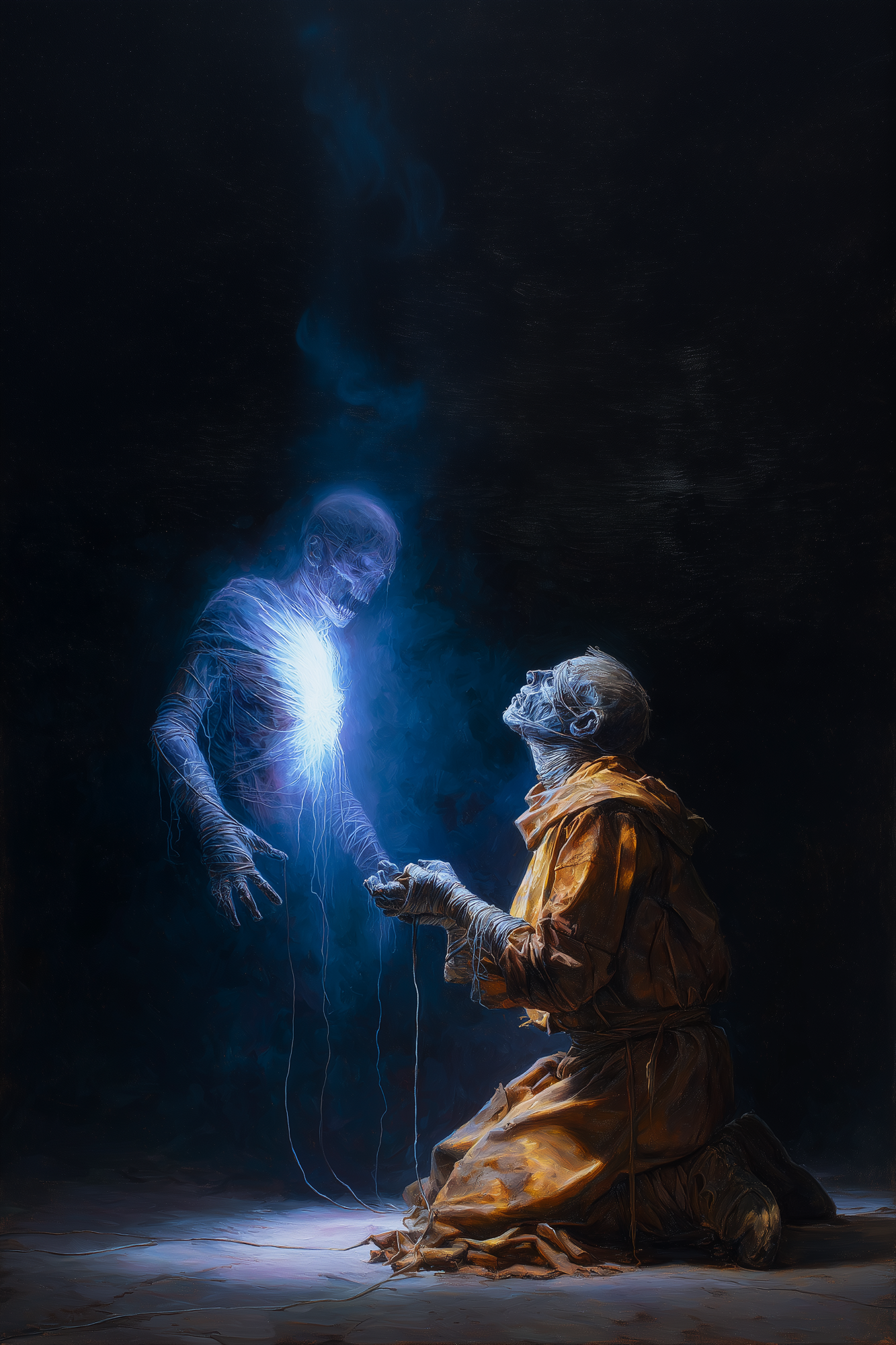
Before their name became a whisper of dread in the Mire, the Fume Born were healers. They were scholars and physicians who believed that life could still be persuaded away from suffering. They came to the drowned cities with bandages and quiet faith, certain that every wound could be treated, every death delayed if not denied.
The Mire taught them a different truth. The wound they tried to mend was older than kingdoms and older than grief. It was not an illness resting inside the world. It was a flaw in the first design of creation.
When their medicines failed and their prayers dissolved into the fog, they turned to a deeper craft. They named it Serathic Alkymy, a sacred science that uses death, light and memory as its reagents. No longer content with healing broken bodies, they sought to revise the pattern that allowed bodies to break at all.
They spoke of a coming reality, a deliberate second creation laid over the first. They called it the Second Veil, a place where thought, will and light would hold more weight than flesh.
Their laboratories became chapels. Their scalpels became hymns. Their failures became scripture. Blue, red and gold light seeped into the drowned streets, reflected in canals of alchemical runoff that flowed like liquid dawn between towers of black stone and whispering glass.
They did not stop death. They began to record it. Every final heartbeat was etched onto thin circles of glass called Echo Plates. Every lost breath, every shudder, every last fragment of will became data for the world yet to come.
“We do not fear the end,” they whisper.
“We are the architects of what follows.”
II. LORE: PRACTICES OF THE FUME BORN
The Crucible Towers and the Shimmering Breath of Dawn
Each drowned city of the Mire is built around a Crucible Tower, a breathing engine of iron and glass that exhales colored mist into the night. The towers are linked by canals of luminous runoff that cross the streets in slow currents. When seen from above, those currents draw vast sigils across the city, lines of living equation only the Fume Born attempt to read.
Initiation begins with exposure. Novices stand beneath the tower vents and breathe in thin streams of measured vapor. Their blood cools. Their veins grow pale. Their senses stretch until the weight of light and sound becomes almost unbearable. Those who survive speak of hearing a distant pulse beneath the world. They call it the Pattern, the heartbeat of Eidola Serath far below the Mire.
Rituals are timed like equations. Candles are measured by pulse. Chants are counted by breath. No death passes unrecorded. The last beats of every heart are inscribed on Echo Plates and slid into vaults beneath the towers, waiting for the day when all that stored rhythm will be fused into the foundations of the Second Veil.
They raise no armies. They conquer no nations. They work in increments of lives, revising creation one ending at a time.
III. FRAGMENT OF THE FUME BORN
The Architects of the Second Veil
“All medicine failed.
So we turned to creation itself.”
The Mire remembers the first breath of our kind. We arrived with bandages and simple prayers, certain that the world could still be convinced to live. The air took us. The fog entered our lungs and replaced our blood with light.
Now we breathe in color. Our hearts no longer beat, they vibrate. They measure the rhythm of what remains.
We have built sanctums of black stone and glass where every vial sings with its own pulse. Each drop of distilled soul becomes another brick in the foundation of the world that waits behind this one.
Our masks do not hide sickness. They filter truth. Our chants are not pleas to the sky. They are equations written in breath.
At night the drowned streets glow with pale fire. We open the valves of the Crucible Towers and let a new mist rise into the dark, a slow transfusion between the first world and the second.
The old healers call us heretics. The dying call us saviors. We call ourselves corrections.
“The first world was flesh,” we whisper.
“The next shall be intention.”
IV. CODEX OF THE FUME BORN
Seekers of the Second Veil
“The soul must be transferred, not escaped.”
The Fume Born do not dream of fleeing mortality. They treat the mortal plane as a patient, an unfinished body awaiting careful revision. In their doctrine the world has fallen from its first intention, stained by cruelty until even death has forgotten how to mean anything.
Their purpose is not retreat. Their purpose is passage.
They believe the soul can be carried through the fumes into a new medium of existence without losing memory or will. The Second Veil is envisioned as a realm of clear awareness, where thought and light have weight, where sorrow does not rot but is refined into understanding.
Yet in pursuing this distant beauty they have turned their own cities into mausoleums of light. Vats of radiant liquid line the streets. Walls hum with the breath of experiments still in motion. Windows shine with the colors of lives that did not survive the process.
No two Fume Born are shaped the same. Each body is an individual theory. Some breathe vapor instead of air. Some carry luminous serum in place of blood. Others have carved symbols into bone so that even their skeletons will continue to calculate after death.
They do not think of themselves as necromancers. They think of themselves as engineers of the after life.
“We do not worship death,” they whisper.
“We study it until it becomes art.”
V. LORE: METHODS OF THE FUME BORN
Cells, Vats and the Sacred Silence of the Mire
The drowned cities are divided into Cells, autonomous circles of surgeons, philosophers and chemists. There is no single doctrine, only results. Each Cell follows its own path toward the Second Veil, and each tower keeps its own ledger of failures.
In one city the dead are submerged in tall glass vats filled with tri colored liquid, red for life, blue for thought, gold for spirit. Their essence unwinds in slow spirals and is drawn off as sacred vapor that the faithful inhale during long vigils.
Elsewhere the dying are surrounded by mirrors. Their final breath fogs the surface, and that fog is scraped away and sealed in crystal globes that glow faintly when pressed against a living chest. The globes are stored in echo libraries, where they dim by degrees but never quite go dark.
Other Cells attempt resonance grafting, binding souls together in shared rhythm. They argue that eternity will not be reached through purity but through union, a chorus too complete to be unmade.
Every method is recorded, never judged. Failure is revelation written in different ink.
Towers are stacked with journals of soot and blood, notes on how long a memory can be heard in the fog, or how light behaves inside a body that has already decided to die.
Those who survive their own procedures become living scriptures of the process. Veins glow beneath translucent skin. Eyes shimmer in patterns that pulse like equations.
In their sanctums, the hiss of steam blends with the murmur of prayer. Experiment and ritual have merged so completely that no one remembers which began first. To watch a Fume Born at work is to see religion dissect itself in search of beauty.
VI. CODEX OF EIDOLA SERATH
The Pale Surgeon
“The body can be mended.
The soul can be redrawn.”
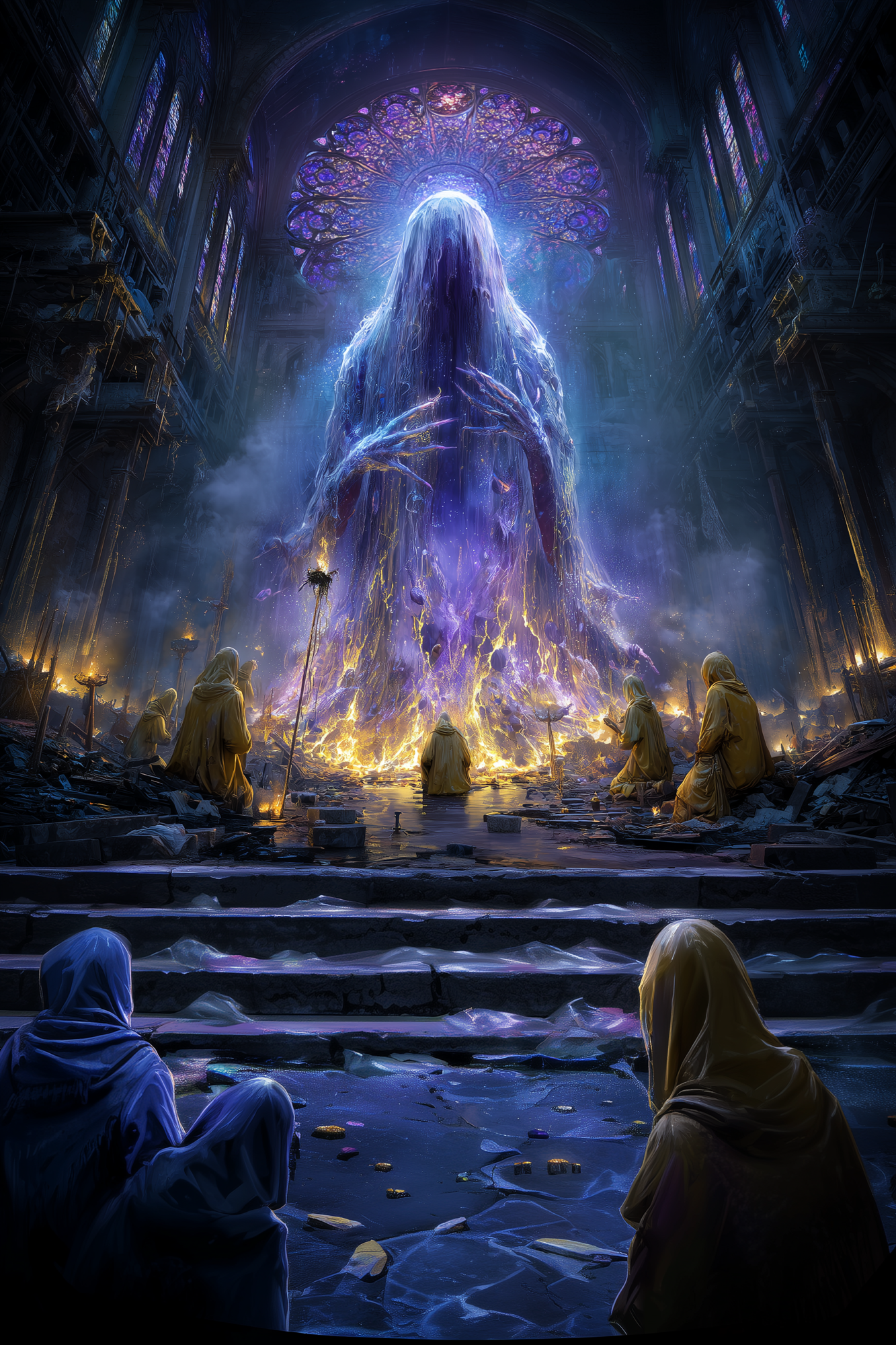
At the heart of the Mire stands the Obsidian Sanctum, a cathedral that breathes. Its arches sweat with liquid color, and rivers of luminous plasma run beneath its floor. This is the domain of Eidola Serath, the Pale Surgeon, the physician who refused to accept that death was a final answer.
In forgotten centuries she walked the world as a healer without equal. She studied the structure of the soul with the same care others reserved for bone and nerve, and came to a single conclusion. Life itself was a flawed equation.
Her last experiment was herself. She opened her chest to see whether the soul would flee or change. It changed. Her heart became a glass engine that burns in three steady colors, blue for thought, red for will, yellow for light. She rose from the table as something both woman and principle.
Now she moves through the Sanctum like a slow eclipse. Her hands end in talons of bone and crystal. Her voice hums through the pipes, and those who hear it find their pulse falling into rhythm with hers.
To the Fume Born she is the Mother of Correction. They bring her relics, memories and bodies in jars. She does not answer prayers. She revises them.
“Be silent,” she murmurs.
“The world is on the table.”
VII. LORE: THE SANCTUM AND THE SURGEON
Where Correction Breathes
The Obsidian Sanctum is more than a cathedral. It is a living apparatus wrapped around her transformed heart. Every pulse in the rivers beneath the floor matches the beat of the Serathic Core. When she inhales, the stained glass windows flicker with silhouettes of bodies in slow revision. When she exhales, the walls shift as if remembering the shapes they were meant to hold.
Those who serve inside are her assistants. Their robes shimmer in pale gold and ashen red. They record each motion of her hands on metal tablets called Sutures of Light, lines of formula and rhythm that describe the choreography of creation.
Sound bends toward her. Speech is rare. Even whispers feel like intrusions in a place where the heartbeat of the Surgeon is the only true voice.
Some claim she is not confined to the Sanctum at all. They insist her presence is diffused through every canal and cloud of the Mire, a pressure behind every alchemical breath. Others swear they have seen her full form, towering and calm, haloed by vapor as she takes a life apart and offers it back in a different arrangement.
Her followers do not call her goddess. They call her the Last Physician, the one who treats the sickness of being alive.
VIII. FRAGMENT OF EIDOLA SERATH
The Mother of Correction
“She does not dream.
She drafts.”
Deep below the Mire the air beats with a rhythm that belongs to no wind. Each breath from her lungs fills the pipes with sound. When she exhales, the fluids in the walls shimmer and rearrange, obeying a prescription older than the cities built above her.
Her hands move with slow mercy. Where she touches, bone softens and memory hardens. The boundary between the living and the designed dissolves into a quiet glow.
Those she corrects do not die. They are edited.
Sometimes she pauses and tilts her head, listening to something far above, perhaps the faint heartbeat of the surface world. Then she smiles, and the cathedral answers with a long, shivering sigh.
“Lie still,” she murmurs.
“The correction is almost complete.”
IX. LORE: THE COST OF BREATH
What the Fumes Do to a Body
The Fume Born speak of the Second Veil in the language of beauty, but their bodies record a harsher truth. The vapor is not symbolic. It is chemical and ritual fused into one thing that rewrites tissue through repetition.
After the first months of measured exposure the blood cools and thickens. It does not clot correctly. It begins to hold light the way fat holds heat. Veins pale, then glow faintly beneath the skin, not with magic, but with suspended reagent that never fully leaves.
Lungs stiffen. Ordinary breath becomes inadequate. Many Fume Born learn to breathe through their masks before they need them, because the masks become more than filters. They become regulators, keeping the body within a narrow range where the vapor will change it without killing it.
Eyes are the first visible shift. Pupils no longer hold a clean circle. They flicker with patterns that look like calculation. Those patterns are not decoration. They are stress, the body attempting to adapt to sensory weight it was never designed to carry.
When the adaptation succeeds, the Fume Born become calm in ways that unsettle outsiders. Their pulse slows. Their reactions delay. Their speech turns precise. Their bodies treat urgency as an impurity.
When the adaptation fails, the body does not simply die. It becomes unstable. Breath becomes luminous fog. Skin turns thin as wet paper. Memories begin to surface in the wrong places, in eyes, in fingernails, in the saliva of the dying. The Fume Born call these outcomes data. Everyone else calls them warnings.
X. INITIATION RECORD
Excerpt from Tower Ledger 4, Crucible City unnamed
Entry: Novice Exposure Sequence, first cycle
Conditions: Mist ratio reduced. Vent duration shortened. Choir count increased.
The novice stood beneath the vent with hands open, as instructed. The vapor did not rush. It arrived like a slow tide, pale blue first, then a thin edge of gold that stung the eyes.
Breath one. No distress.
Breath two. Skin temperature drops.
Breath three. The novice’s pulse slows, then becomes uneven. The chest rises with effort, as if the lungs are learning new weight.
The choir maintained rhythm. The candles were counted. The towers answered with a soft hiss.
On breath seven the novice began to cry without sound. Tears ran clear, then faintly luminous. The hands shook, then steadied. The novice whispered that the world had a second heartbeat under it.
The mask was applied after the first tremor. The tremor stopped. The novice’s eyes altered. Not color, pattern. The pupils held a flicker that did not belong to fear.
Result: Survived. Marked for Cell assignment. Echo Plate prepared in advance.
XI. CONTAINMENT PROTOCOL
Why the Cells Work in Silence
The drowned cities look like sanctuaries from a distance. Up close they feel like containment made beautiful. The Fume Born build their lives around limits, because the vapor will spread if it is treated casually.
Crucible Towers are calibrated to the city, not the sky. Their vents do not open freely. They open on count, on pulse, on ledger. Canals of runoff are not merely aesthetic. They are transport lines for excess reagent that must be moved away from living quarters before it settles into walls and begins to hum.
Cells do not share doctrine because doctrine tempts imitation. They share measurements. The sacred silence is not humility. It is safety. A mistake repeated across cities becomes a plague made of breath.
Outsiders often assume the masks exist to hide faces. That is the least of their purpose. The masks prevent the Fume Born from breathing the Mire raw. Without filtration and control, the air would enter them unmeasured, and the body would correct itself in directions no one can record.
XII. FAILURE LEDGER
Recovered note, sealed to an Echo Plate with black wax
Subject accepted vapor too quickly.
It was not ambition. It was impatience disguised as devotion. The subject removed the mask during the vigil to taste the truth without regulation.
At first the change looked holy. The veins brightened. The skin turned almost translucent. The subject spoke clearly and calmly, as if the Second Veil had already opened in the chest.
Then the breathing failed.
Not cessation. Transformation. Each exhale produced a thin luminous fog that did not disperse. It clung to the chamber. It held fragments of sound inside it, partial words, remembered names, unfinished prayers.
The subject’s eyes lost their pattern and became blank light. The hands clawed at the throat. No bruise formed. The body was not choking on air. It was choking on weight.
When the subject collapsed, the fog did not leave. It drifted toward the walls and settled into the stone like damp. The chamber now hums. The hum repeats the subject’s final rhythm.
We sealed the Echo Plate and moved it beneath the tower. We will not call this tragedy. We will call it a measurement we will not repeat.